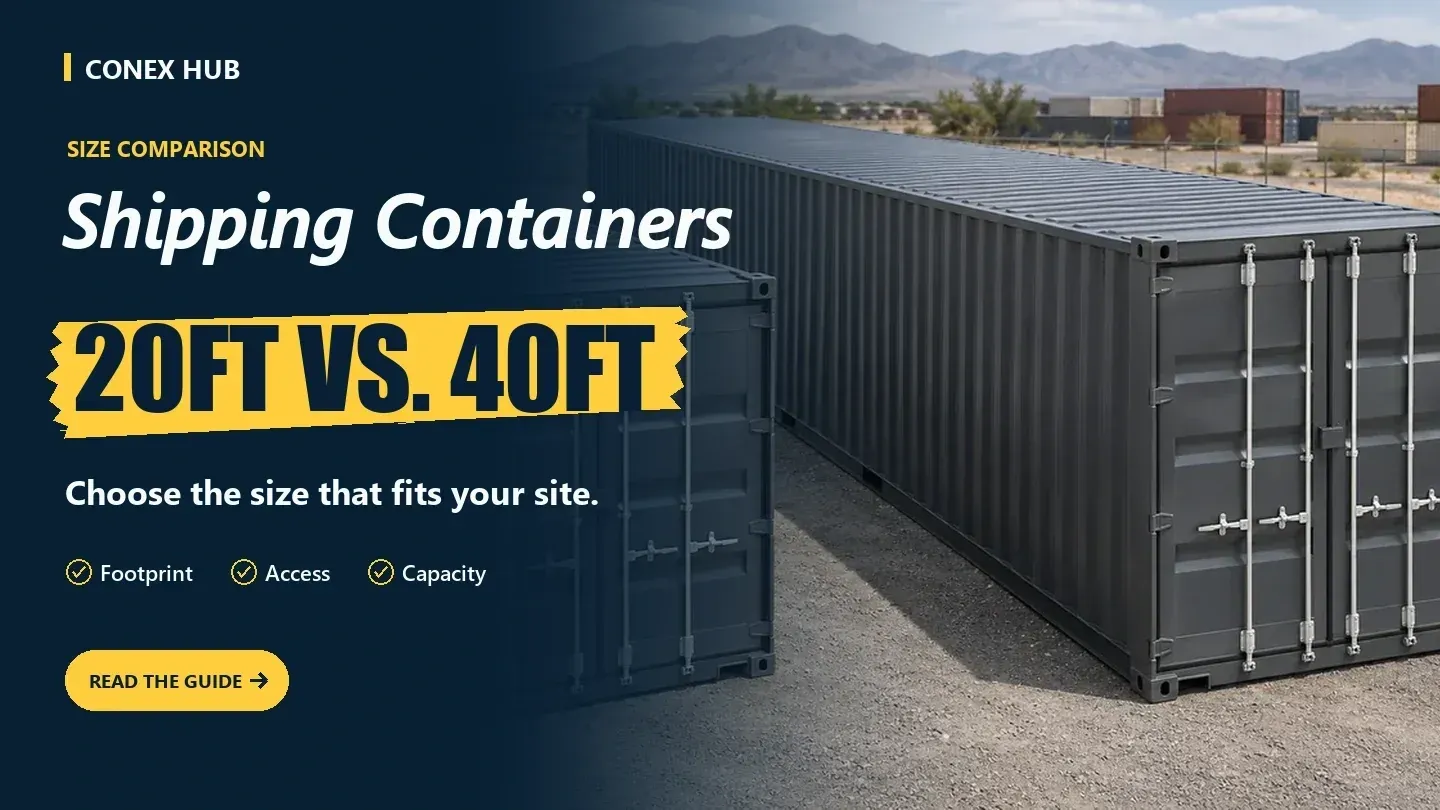
20ft vs. 40ft Shipping Containers: Which Size Fits Your Site?
Compare 20ft and 40ft shipping containers by footprint, access, storage layout, and delivery clearance before requesting a quote.
Quick answer
Choose a 20ft container when you need a compact footprint and can reach everything without moving half the inventory to get at the rest. Lean toward a 40ft container when you need room for bulky equipment, several inventory zones, or a longer working aisle. But size the site, not just the load: confirm delivery clearance and door access before you decide, because a container that fits the finished layout still needs a workable route to reach its spot. The right answer is usually the smallest unit that holds your load and keeps it accessible — a bigger box you can't retrieve from efficiently is a false economy.
Compare usable space before comparing price
Standard 20ft and 40ft containers commonly share a nominal exterior width of 8 feet; what differs is roughly 20 feet of length. But nominal numbers are not what you store into. Interior dimensions, the clear door opening, and the raised threshold all vary by unit, and every one of them is smaller than the exterior figure. Before you plan shelving, measure your widest and tallest items in the exact orientation they will enter — including wheels, handles, packaging, and any pallet jack or cart that goes in with them.
Then sketch shelves and aisles to scale. A 40ft unit buys you length for separate zones, but it is still a single box with one set of doors at one end, which means items at the back can become genuinely inconvenient to reach. Keep fast-moving inventory near the entrance regardless of size. If you truly need to get at both ends, ask about a double-door configuration before you assume more length solves the access problem.
Three practical examples
Contractor tools. A 20ft container often works beautifully here. Crews grab hand tools, small equipment, and consumables each morning, so the priorities are a clear lane for carts and frequently used items near the door. Measure your largest piece of rolling equipment before choosing shelf depth, and leave one wall flexible for the awkward long items that don't fit a rack.
Retail overflow. A 40ft unit can make sense for seasonal stock that arrives in waves, provided you can keep a receiving lane open and label each inventory zone. But if merchandise turns over quickly, accessibility beats raw carton capacity — a packed 40ft box that forces constant restacking will slow your team more than a 20ft one they can actually walk.
Mixed equipment and inventory. Map the turning space needed to move bulky items around your shelving, not just through the doors. A load can clear the door opening and still be impossible to turn into position inside. If that's a risk, revise the layout, reconsider shelf placement, or look at a different door configuration before committing to the larger unit.
Compare the site as well as the container
The container has to get there. Check truck access, unloading space, gate width, the final footprint, and a clear door swing before you choose a size. Conex Hub publishes different straight-line planning figures for 20ft and 40ft tilt-bed deliveries — roughly 60 feet of clearance for a 20ft unit and at least 100 feet for a 40ft one — and the gap between them is exactly where site constraints force the decision. A site that comfortably takes a 20ft drop may not have the runout for a 40ft truck. Review the delivery guide and send site photos if you are deciding between sizes; the access answer often settles the size question on its own.
A comparison to take to the yard
| Decision | 20ft container | 40ft container |
|---|---|---|
| Footprint | Shorter run on the site | Requires room for a longer footprint |
| Organization | Easier to keep a single work zone close to the doors | More length for separate stock or equipment zones |
| Delivery | Check the shorter tilt-bed planning figure with dispatch | Confirm the longer approach and unloading runout |
| Retrieval | Everything within a few steps of the doors | Rear items need a plan or a second door |
| Best field test | Sketch the largest load and its retrieval path | Sketch the zones and check access to the rear |
Bring your scale sketch and the dimensions of the largest load when you compare units at the yard. If two doors or a high cube turn out to be part of the solution, ask for that exact configuration in the quote rather than assuming the standard unit will do.
Should I consider a high cube?
Consider a high cube — a foot taller than standard at 9'6" — if the load or an internal build needs the extra headroom, for example tall racking, stacked pallets, or a conversion with a finished ceiling. Confirm the specific clear door opening, and check both the delivery route and the placement area for overhead obstructions, since the added height can matter under wires, awnings, or a roofline.
What if I might need more space later?
Weigh one larger unit against starting with a 20ft and adding a second unit when you need it. Buying one 40ft now is simpler to deliver once and manage as a single space. Two 20ft units cost a second delivery and a second footprint, but they let you separate inventory cleanly, place storage in two locations, and scale only when the need is real. Compare 40ft inventory against the same condition and access requirements before you decide which path is cheaper over the life of the project.
Is a 40ft always better value per square foot?
On the unit price, a 40ft usually costs less per square foot of floor than a 20ft. But value per square foot only counts if you can use and reach that floor. Factor in the larger footprint, the tougher delivery, and whether the rear space will actually be accessible — a 20ft you fully use can beat a 40ft you half-use.
Get a quote from Conex Hub
Share your project details, delivery ZIP code, and target date when you request a quote. For more information, see 20ft container options.