Containerized Battery Storage Enclosure RFQ Guide for EPC Teams
Build a clearer battery enclosure RFQ with equipment schedules, thermal design inputs, service access, safety interfaces, and shipping requirements.
Quick answer
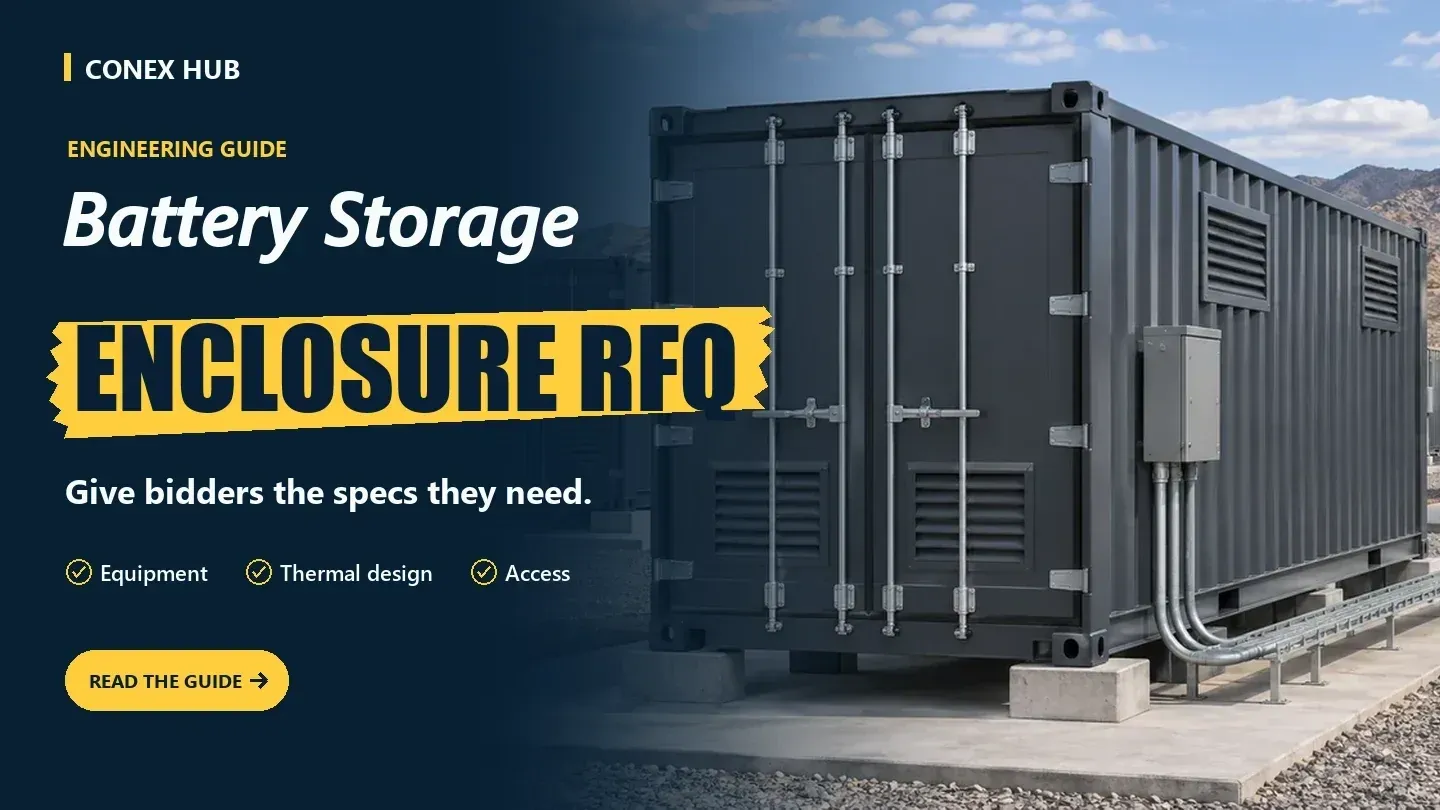
A comparable enclosure quote begins with a clear scope boundary. Before any bidder can price your containerized battery energy storage enclosure fairly, they need to know exactly what they are pricing: the bare shell, a fabricated enclosure with equipment interfaces, or a more complete assembly with thermal, electrical, and safety systems integrated. Define that boundary first, then identify who owns each design decision, approval, installation task, and test. Keep those responsibilities explicit in the RFQ so every bidder prices the same deliverable — otherwise you will compare quotes that only look like each other.
The U.S. Energy Information Administration reported 43.6 GW of operational U.S. battery storage capacity at the end of 2025, with additional capacity planned by operators. As that pipeline turns equipment specifications into deployable enclosures, a disciplined RFQ is what keeps bids comparable and schedules honest. The inputs below help EPC teams define scope early and avoid the change orders that come from assumptions made in the dark. EIA battery storage report
Start with equipment and site inputs
Give bidders the physical reality they must build around. Provide the equipment schedule, rack dimensions, weights, mounting details, and service clearances, and state the installation sequence — what goes in first, and which parts must be removable for service later. Document the site conditions that drive the enclosure design: the ambient temperature range, elevation, corrosive or coastal exposure, seismic or wind considerations, and any project-defined structural design criteria. Rather than guess at code, ask the project engineer to identify the applicable requirements for the specific location and system configuration, and reference them in the package so no bidder has to invent a design basis.
Define thermal and safety interfaces
Thermal and safety scope is where battery enclosure bids most often diverge, so define the interfaces precisely. Share the expected heat loads and the equipment's environmental limits, and state clearly which party designs and supplies the thermal management equipment, and who provides power, controls, and monitoring for it. Define responsibility for detection, alarms, emergency interfaces, and any fire or gas protection systems specified for the project. List the documents bidders should design to, and explicitly ask them to flag missing inputs before assuming a design basis — a bidder who quietly assumes is a bidder whose price will change.
Resolve access, penetrations, and shipping early
Settle the physical logistics before they become field problems. Provide a preliminary plan showing door locations, access aisles, cable entries and other penetrations, lifting points, and the clearances needed for installation and service. Ask each bidder for the transport envelope and shipping weight in the configuration they are proposing, and clarify what ships installed versus loose, and who is responsible for rigging, site placement, and final connections. Have the relevant engineers and carriers confirm the handling requirements, since an enclosure that is cheaper to fabricate but impossible to ship in one piece is not actually cheaper.
Make bids comparable
Ask for the detail that lets you read quotes side by side: an itemized scope, stated exclusions and assumptions, drawings, a schedule, an inspection plan, and the acceptance deliverables. Where it applies, have bidders separate design, fabrication, coating, electrical integration, and freight into distinct lines so you can see where each bidder's number actually sits. Ask whether their quoted lead times depend on receiving approved drawings or final equipment information by a particular date — because a lead time that assumes instant approvals is a schedule risk, not a commitment.
Ask for an interface matrix with the proposal
| Interface | Information to request |
|---|---|
| Equipment mounting | Attachment points, load inputs, drawings, and design ownership |
| Electrical and controls | Cable entry locations, connections, and integration boundaries |
| Thermal management | Heat-load assumptions, equipment scope, and verification method |
| Fire and gas safety | Detection, alarms, emergency interfaces, and protection-system scope |
| Service access | Replacement paths, access doors, and clearance assumptions |
| Transport and placement | Shipping dimensions, weight, lift information, and scope boundaries |
If one bidder includes factory integration and another prices only a fabricated shell, do not compare the headline numbers directly — compare them after you estimate the work that still remains on site for each. Request a list of each bidder's open questions, and ask them to separate any alternatives or value-engineering options from the base bid so the base stays comparable across bidders.
Keep the scope boundary stable through the bid
Scope drifts during a bid cycle, and drift destroys comparability. When you answer one bidder's question or add an input, issue the clarification to every bidder, and log each revision so the final quotes all reflect the same package. If the design basis changes materially mid-bid, reset the clock rather than let bidders respond to different versions of the same RFQ. A tightly controlled package costs a little discipline up front and saves the far larger cost of re-bidding or arguing change orders later.
What should be in the first RFQ package?
At minimum: a layout, the equipment schedule, the site design inputs, an interface-and-responsibility matrix, and a delivery schedule. Label any preliminary information clearly as preliminary, so bidders can identify which of their cost and schedule assumptions depend on it firming up.
Who should establish the applicable requirements?
Assign the project's qualified design team to establish and coordinate the applicable requirements with the relevant authorities, equipment suppliers, and system providers. Reflect their decisions in the bid package and in the acceptance criteria, rather than leaving each bidder to interpret the codes independently.
How do I compare a fabricated shell against a full assembly?
Normalize them. Take the lower-scope bid and add a realistic estimate of the remaining design, integration, and field work needed to reach the same finished state as the higher-scope bid. Compare the normalized totals, the schedules, and the risk each approach leaves on your side of the fence — not just the quoted prices.
Get a quote from Conex Hub
Share your project details, delivery ZIP code, and target date when you request a quote. For more information, see Conex Hub's energy storage capabilities.