How to Prevent Condensation Inside a Shipping Container
Find out why shipping containers sweat and how to reduce moisture with dry loading, ventilation, monitoring, and suitable insulation.
Quick answer
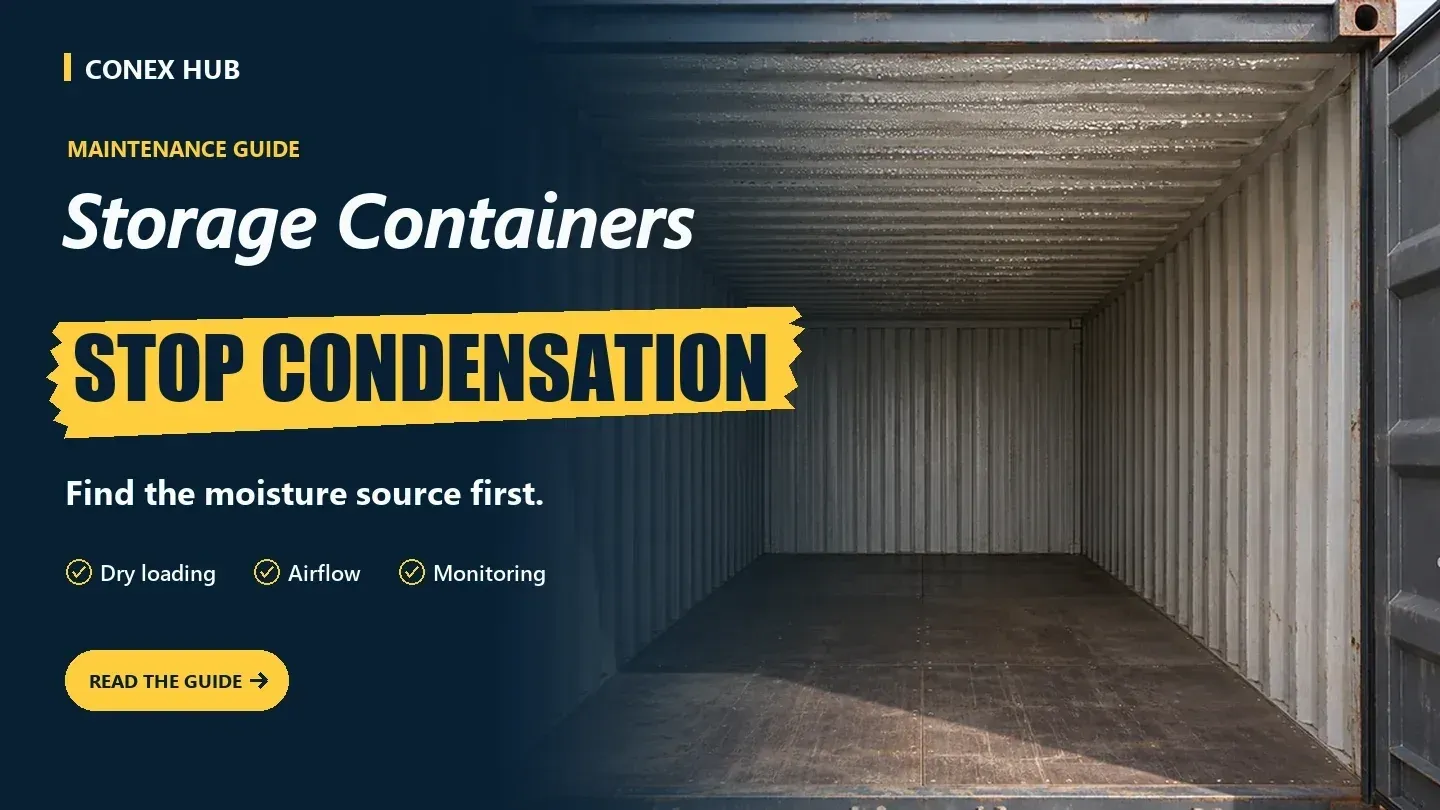
Shipping containers collect condensation when moist air meets steel that has cooled below the air's dew point — most often overnight, when the roof and walls lose heat fast and water beads on the inside like a cold drink in summer. It is sometimes called "container rain," and left unchecked it can stain cartons, rust tools, and grow mildew. The first and most important step is to find out where the moisture is actually coming from. If you load damp equipment or wet cardboard on Friday, adding vents alone will not fix it. If water appears next to a seam only after rain, you may be dealing with a leak, not condensation at all. Diagnose before you spend.
Look for the moisture pattern
The pattern tells you the cause. Widespread droplets across the ceiling and upper walls after a cool night point to condensation — moisture already inside the box, settling out as the steel chills. A recurring wet spot near a single door gasket or an old roof repair, appearing after rain, points to water getting in from outside. The two problems have different fixes, so it is worth the few days it takes to be sure.
Record when the moisture appears and photograph the area before you wipe it dry. A simple temperature and humidity logger left inside for a week or two is one of the cheapest, most useful tools you can buy: it connects the wet mornings to overnight temperature swings and to your own loading activity, and it turns a guess into evidence you can act on.
Keep moisture out at loading
Most container sweat is moisture you carried in yourself. Let washed equipment, lumber, and outdoor gear dry fully before storing them. Replace wet or already-damp cartons, and inspect pallets before they go in — a stack of humid cardboard can release surprising amounts of water into a sealed steel box. Keep vulnerable goods up off the floor where practical, and leave a little separation from the steel walls so air can move and so you can inspect for moisture later. If inventory arrives damp, isolate and dry it before you pack the container tight; sealing humidity in is how a dry-looking load sweats a week later.
Match ventilation and insulation to the use
Ventilation helps when the outside air is drier than the air inside, because it lets the trapped moisture escape. But outdoor air can also carry moisture in on a humid or foggy day, so observe your local conditions before adding vents rather than assuming more airflow is always better. Wherever you do rely on airflow, don't block it: avoid stacking shelving or cartons tight against the vents or across the path the air needs to travel.
For a container that will be regularly occupied or temperature-controlled — an office, a workshop, a break room, a controlled-storage build — treat moisture as a system, not a single product. Ask a qualified fabricator to consider insulation, air sealing, vapor control, and ventilation together. Insulating a wall without addressing the moisture paths behind it can trap water in places you cannot see or inspect, which is worse than leaving the wall bare.
Choose a monitoring and maintenance routine
Build a simple habit around the moments moisture is most likely: after rain, after a major restock, and after a sharp swing in the weather. Inspect the ceiling corners, the door seals, and the backs of shelves where air stagnates. Desiccant — moisture-absorbing products made for containers — can handle a limited moisture load if it is correctly sized for the volume and replaced on schedule; it is a maintenance item, not a one-time fix. For sensitive goods or a problem that keeps returning, look at whether controlled storage or a properly sized powered dehumidifier can hold the conditions you actually need.
A two-week troubleshooting log
If sweat is recurring, keep a short daily log for two weeks. Each entry: the time, the outdoor weather, the indoor temperature and humidity if you have a logger, and whether the doors were recently opened. Mark the affected location on a simple sketch of the interior.
Start with the two zero-cost fixes — dry loading and airflow around the goods — and watch what the log shows. If the same spot wets specifically after rain, have it inspected for intrusion. If droplets appear broadly after overnight temperature changes, that is classic condensation, and the log gives you the evidence to discuss ventilation or climate control with your supplier instead of guessing. For genuinely valuable inventory, agree the acceptable conditions with the product supplier in advance, and arrange alternate storage if the unit cannot hold them while you diagnose the cause.
Climate changes the playbook
There is no single fix that works everywhere, because the right approach depends on your goods, your loading habits, how far the temperature swings day to night, and whether the box is sealed storage or an occupied, powered space. A humid coastal site, a dry inland yard, and a location with hard overnight temperature drops each stress a container differently. Diagnose the pattern in your conditions first, then match the remedy — dry loading, ventilation, desiccant, insulation, or active climate control — to what the evidence actually shows.
Can a wind-and-watertight container still sweat?
Yes, and this surprises people. "Wind and watertight" means the box resists water coming in from outside. It says nothing about condensation forming from the moisture already inside, or from humid air introduced every time the doors open. A perfectly sealed container can still rain on the inside.
Is one fix enough for every climate?
No. The right combination depends on the goods, the loading routine, the temperature swings, and whether the container is occupied or powered. Diagnose the pattern before paying for a modification, because the wrong fix — insulating over a moisture path, or venting in humid air — can make things worse.
Do I need a dehumidifier or will desiccant do?
It depends on the moisture load and whether the unit has power. Desiccant suits a sealed box with a modest, intermittent moisture problem and a willingness to replace it on schedule. A powered dehumidifier suits a larger or persistent load where electricity is available. Size either one to the container volume and the conditions your goods require.
Get a quote from Conex Hub
Share your project details, delivery ZIP code, and target date when you request a quote. For more information, see used container options.