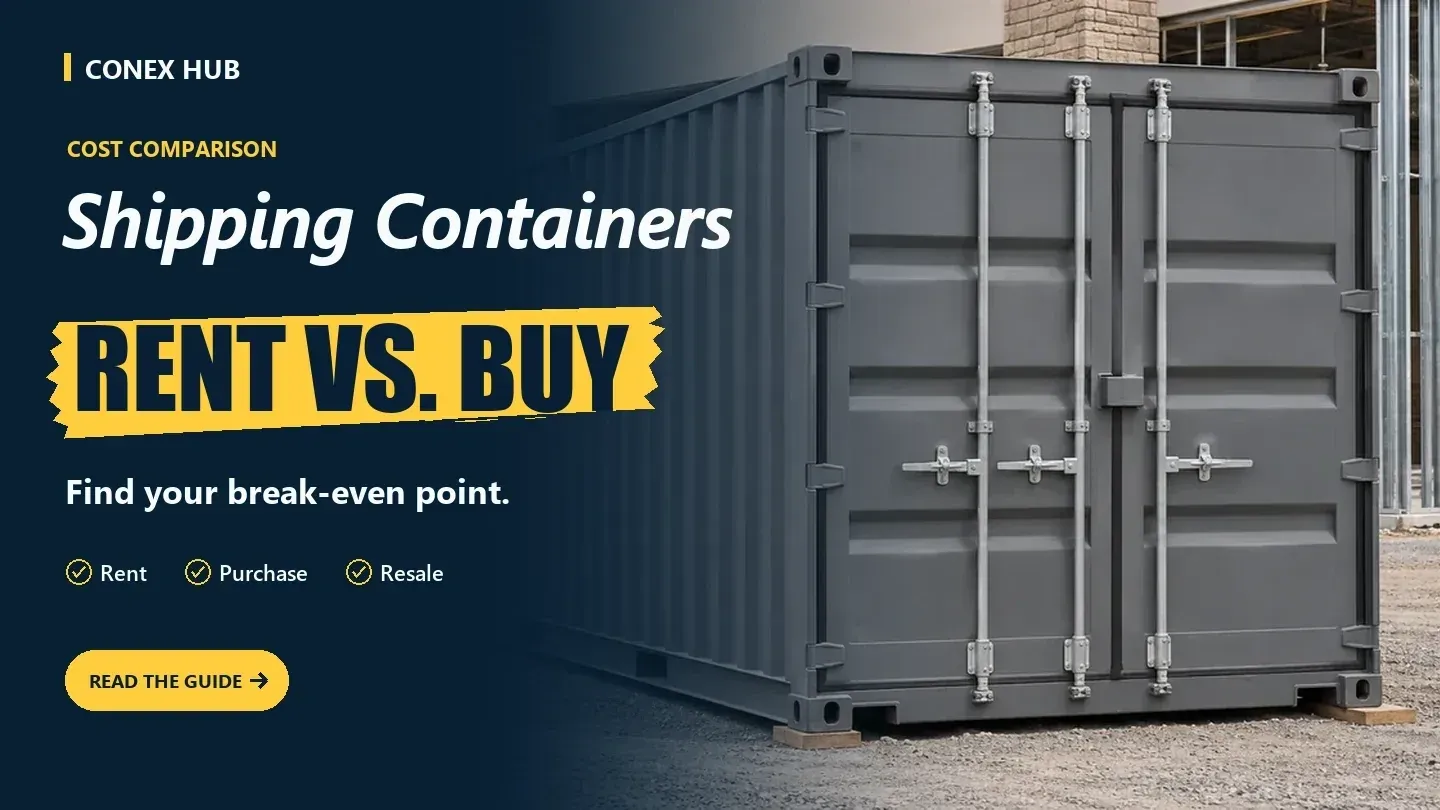
Rent vs. Buy a Shipping Container: Find Your Break-Even Point
Compare rental and purchase costs with an example that accounts for monthly rent, delivery, pickup, resale, and project delays.
Quick answer
Renting is often the right fit when a project has a clear end date and you want pickup built into the plan from the start. Buying deserves a closer look when the storage will run continuously, move between projects, or be customized into something purpose-built. The mistake most buyers make is comparing a monthly rental rate against a purchase price as if they were the same kind of number. They are not. To decide well, put both options on the same timeline and include every cost of getting the container onto the site — and, just as important, back off it again.
This guide shows how to line the two up honestly, works a break-even example you can copy, and flags the cases where the contract terms matter more than the math.
Put both quotes on the same timeline
For a rental, add delivery, pickup, the monthly charge, and any applicable fees into one total for the period you expect to hold the unit. Then read the contract for the details that quietly change that total: when the billing clock starts (delivery day, or the first of the month), whether there is a minimum term, and how much notice pickup requires. A project that wraps up mid-month can still trigger another full billing period if the contract bills in whole months and you miss the notice window.
For a purchase, add the unit price, delivery, any immediate repairs or upgrades, financing costs if you are not paying cash, and — the line buyers forget most — the cost of removal at the end. Only subtract resale proceeds if you can estimate them with some confidence. A buyer who comes and collects the unit and a buyer who expects you to arrange and pay for transport leave you with very different net numbers.
Example: a six-month job that might last a year
Assume a rental is $225 per month with $350 delivery and $350 pickup. The six-month total is $2,050, and the twelve-month total is $3,400.
Now assume a purchase costs $3,500 delivered. If you can net $1,200 after resale and removal, the ownership cost is $2,300 before maintenance, financing, or taxes. Under those assumptions the two options meet at about 7.1 months — rent for a shorter job, buy for a longer one.
The crossover is sensitive to resale, so test it. At eight billed months, the rental would cost $2,500, making ownership look better. But if resale nets just $500 instead of $1,200, ownership costs $3,000 and the crossover moves out to about 10.2 months. These are illustrative numbers; plug in your own rate, your own delivery and pickup charges, and your contract's billing interval before you trust any single break-even point.
When the contract matters more than the crossover
Sometimes the better decision has little to do with the arithmetic. A general contractor who must hand over a clean site at the end of a job may prefer a rental purely because pickup is somebody else's problem on a known schedule. A maintenance department with permanent, ongoing storage needs may value owning the unit outright — and the freedom to cut in a door, bolt down racking, or repaint it — more than any monthly saving.
Before you sign a rental, ask about the terms that bite later: permitted alterations, early-termination charges, the pickup-access requirements, and whether moving the unit to another spot on site needs written approval. Before you buy, confirm who will remove the unit at end of life and what comparable units actually resell for in your market, because a strong resale assumption is often the only thing making ownership look cheaper.
A worksheet you can reuse
| Input | Rental | Purchase |
|---|---|---|
| Starting cost | Delivery and setup | Unit, delivery, and immediate upgrades |
| Time-based cost | Billed months and recurring fees | Financing and maintenance, if applicable |
| Exit cost | Pickup, cleaning, or other contract charges | Removal and transport |
| Value at exit | Any refundable amount that actually applies | Expected sale proceeds |
If you are comparing several rental terms, always verify the billing unit before you compare rates. A lower monthly rate tied to a longer minimum commitment can easily cost more on a short job than a higher rate with no minimum. Keep the written estimate and the contract side by side when you decide, so a headline rate never hides a term that changes the total.
Think about flexibility, not just cost
Money is only one axis. Renting keeps you light: if the project is cancelled, extended, or relocated, you adjust with a phone call rather than a resale listing. Buying gives you control: the unit is yours to modify, move, brand, or keep as a permanent asset, and you are not exposed to rate changes or availability at renewal. If your plans are genuinely uncertain, the option that lets you change course cheaply can be worth paying a little more for — or a little less to walk away from.
What if the project may run long?
Price three dates: the best case, the expected case, and a late finish. Pay particular attention to how rental extensions are charged and how quickly you can actually arrange pickup or resale, because an open-ended delay is exactly where a rental quietly overtakes a purchase.
Should I count resale value?
Run the comparison both with and without it. If buying only wins once you assume a strong resale, that is a warning sign, not a plan. Before you rely on it, establish who will physically move the unit and confirm what similar units are selling for in your region right now.
Can I rent now and buy later?
Sometimes. Ask whether the seller offers a rent-to-own or purchase-conversion option, and whether any rent paid applies toward the purchase. If a short project has a real chance of becoming permanent, that path can hedge the decision without committing you up front.
Get a quote from Conex Hub
Share your project details, delivery ZIP code, and target date when you request a quote. For more information, see rental options.