Shipping Container Cost in 2026: How to Compare Delivered Prices
Compare shipping container prices by size, condition, delivery, and add-ons. Use a worked example to compare the true cost of two quotes.
Quick answer
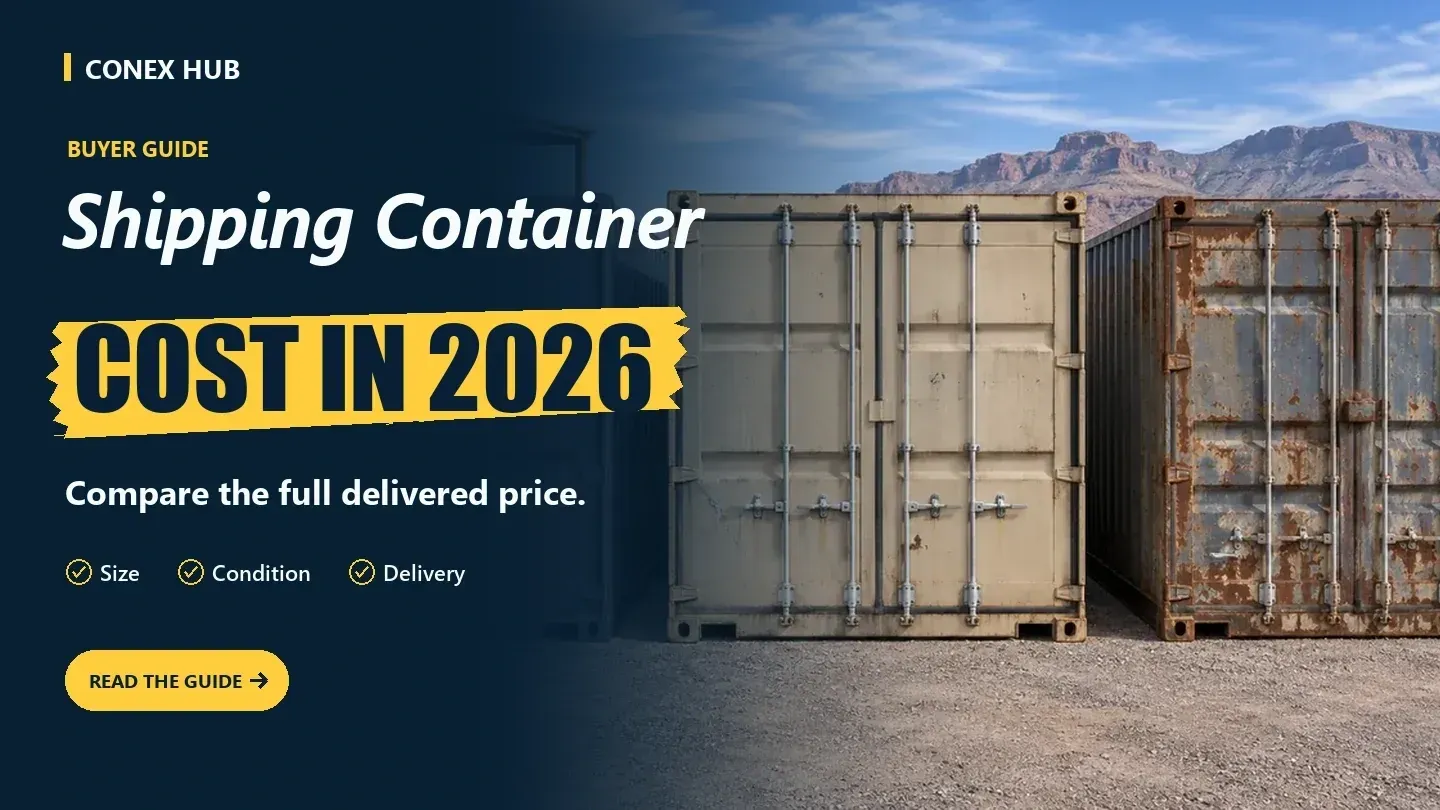
A $2,700 container can cost more to put into service than a $3,000 container. The sticker price is only one line in the real total, and the cheapest unit on a listing page often carries the highest delivery charge, the weakest condition grade, or placement terms that fall apart the moment the truck reaches a narrow gate. Before you compare prices at all, ask every seller to quote the same size, the same condition, the same delivery address, and the same placement requirements. The number that actually matters is the cost to get a usable container standing on your site, ready for the job you bought it for.
This guide breaks down what moves the price, walks through a worked comparison, and gives you a line-by-line checklist so two quotes can be read side by side instead of guessed at.
What determines the price of a shipping container?
Four forces set almost every delivered quote: size and configuration, condition, delivery and placement, and the add-ons or site work the project needs. Treat them as separate budgets rather than a single number, because a saving in one often hides a cost in another.
Size and configuration. Start with the smallest unit that fits your equipment and still leaves room to retrieve it. A 20ft unit is cheaper to buy and far cheaper to deliver than a 40ft one, but only if the shorter footprint genuinely works for your load and access. Standard cargo doors are the baseline; side-opening doors, double doors at both ends, or roll-up doors add cost and are worth paying for only when the way you load the unit calls for them. If a single piece of equipment is close to the listed opening, ask for the clear door opening in inches before you assume it fits.
Condition. Compare one-trip (near-new) units against used units of the same dimensions. A used "wind and watertight" unit can be the right call for yard storage if the floor, doors, and weather seals meet your needs, and it can cost meaningfully less than a one-trip box. A customer-facing location, a converted office, or anything that will be painted and branded may justify paying for a cleaner exterior with fewer repairs. Always ask what the seller's grade actually covers, what it excludes, and request current photos of the specific unit rather than a catalog image.
Delivery and placement. The destination ZIP code, the distance from the dispatch yard, site access, and the unloading method all move the delivered quote, sometimes more than the container itself. A tilt-bed truck needs a clear straight-line run to set a container down; a crane or a forklift is a different cost structure entirely. Ask whether the delivery charge covers your intended placement, and what happens if the driver decides the truck cannot safely reach the spot. A quote priced for an open commercial lot can change the moment the driver has to work through a narrow residential gate or back in from a busy street.
Add-ons and site work. Separate the upgrades you want from the work you need. A lockbox, extra vents, a shelving kit, or a second door changes the container quote. Grading, gravel or a level base, drainage, electrical service, and any local approvals are usually separate project costs that no container seller controls — but they are still part of what the container costs you in the end, so budget them up front.
A worked comparison
Suppose Quote A lists a $2,700 unit, $650 delivery, and a $150 lockbox. Quote B lists a $3,000 unit with $350 delivery and an included lockbox. Before applicable tax and site work, A totals $3,500 and B totals $3,350. On the headline unit price, A looked $300 cheaper; on the delivered total, B is the lower number.
These are illustrative figures, not a quote — but the pattern is real. Before you treat B's $150 edge as a decision, compare the two on condition and placement terms as well. If A is a one-trip unit and B is a used unit with a repaired floor, the "cheaper" delivered total may not be the better buy for your use. Price only means something once the two units are genuinely the same spec.
Ask each seller to spell out any charges that appear only when something goes wrong: a failed or refused delivery, driver waiting time beyond a set window, a relocation on site, or pickup at the end of a rental. If one seller includes a modification, confirm its exact specification and whether it is installed before dispatch or left for you to arrange.
What to send with your quote request
The more precise your request, the more comparable the quotes you get back. Include:
Your delivery ZIP code and, if you have it, the dispatch-to-site distance.
Preferred size and height (standard 8'6" or high-cube 9'6").
Intended use — plain storage, equipment that needs a specific door opening, or a planned conversion.
Date needed, and whether the date is firm or flexible.
Photos of the delivery route: the entrance from the road, the narrowest gate or turn, and the placement spot.
For a used unit, also request the condition grade in writing, photos of the actual unit (not a sample), and a description of any repairs you care about, such as floor patches or roof work.
Ask for a quote you can compare line by line
| Quote line | What to verify |
|---|---|
| Unit | Size, height, grade, door arrangement, and actual-unit photos |
| Freight | Destination ZIP code, delivery method, and placement scope |
| Options | What is installed, when it is installed, and what it costs |
| Site costs | Grading, base work, permits if needed, and electrical service |
| Exceptions | Waiting time, failed delivery, and any redelivery charges |
If you want a market benchmark, collect written delivered quotes for the same configuration within the same week, and record the date and ZIP code next to each figure. Container and trucking prices move with season, fuel, and local inventory, so a quote from three months ago in a different market is not a reliable yardstick. Comparing a pickup price in one region against a delivered price in another is one of the most common ways buyers end up with the wrong budget.
Buying for storage vs. buying to modify
The right spending point depends on what happens to the container after it lands. For plain storage, condition only has to clear the bar of keeping weather out and closing securely, so a sound used unit is usually the value choice. For a modification — an office, a workshop, a controlled-storage build, or anything that will be cut, insulated, or branded — small defects become real costs later. A dented panel where a window will go, a floor you plan to seal, or a roof that already has patches can each add labor to the conversion. If you know the unit will be modified, discuss that with the seller before treating a visual grade as sufficient.
Is a 40ft container twice the price of a 20ft?
No. A 40ft unit holds roughly twice the floor area but rarely costs twice as much to buy, and inventory and trucking can move the two sizes independently. Delivery, however, is not linear: a 40ft unit needs far more straight-line clearance and a larger truck, so its freight and site requirements can rise faster than its length. If your site can accept either size, compare delivered quotes for both and compare usable floor area after allowing for access and shelving.
What should a delivered quote include?
Look for the unit price, condition grade, any modifications, freight, placement terms, applicable charges, and the quote's validity period. Keep those figures separate from any site work you arrange yourself, so you always know the true delivered cost of the container on its own.
How long is a container quote good for?
Ask. Many quotes hold for a set number of days because inventory and freight shift. If your project date is weeks out, confirm whether the price is locked at order or at delivery, and whether a deposit holds the specific unit you were shown.
Get a quote from Conex Hub
Share your project details, delivery ZIP code, and target date when you request a quote. For more information, see used container options.