How Much Space Do You Need for Shipping Container Delivery?
Plan delivery clearance for a 20ft or 40ft shipping container. Check straight-line runout, turns, overhead hazards, ground, and door direction.
Quick answer
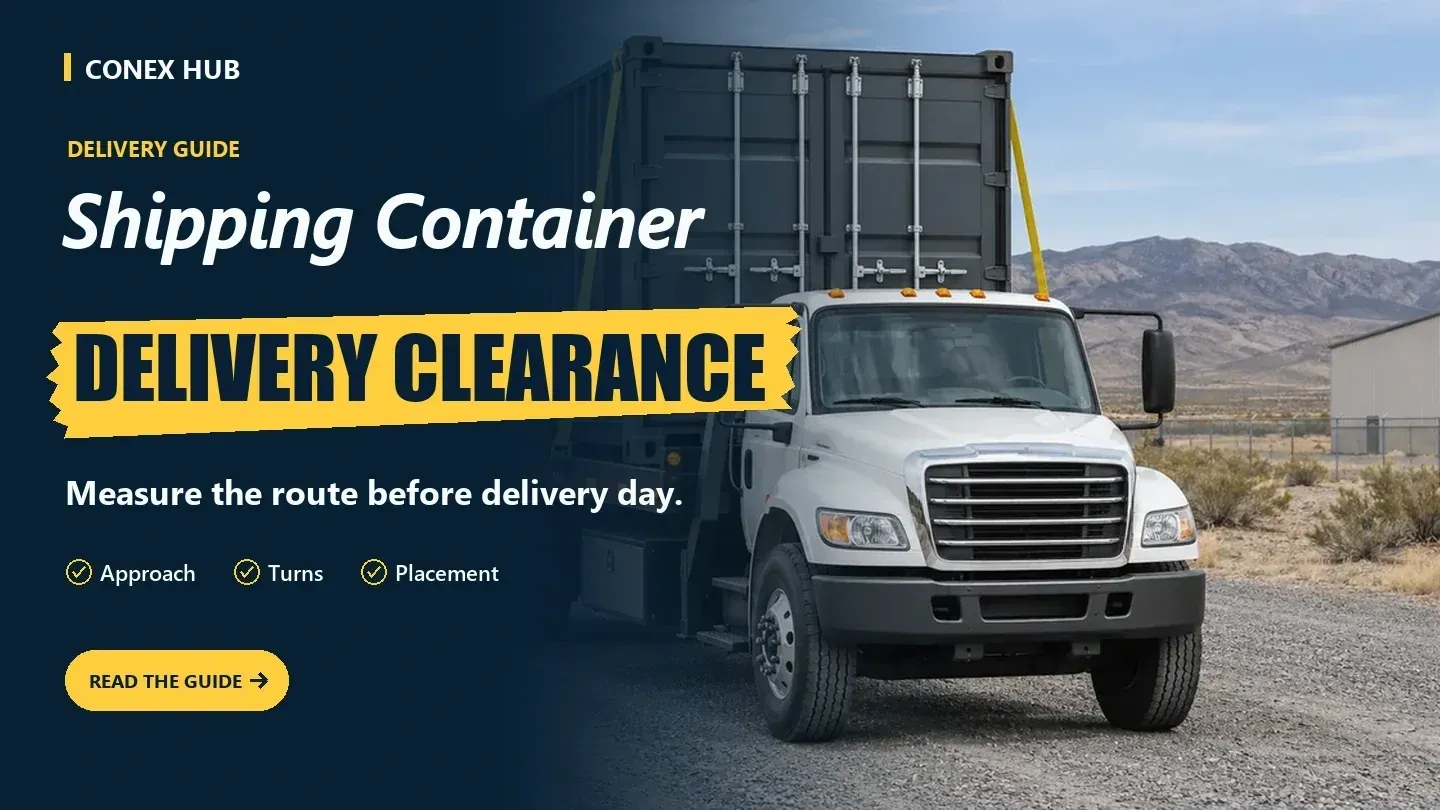
For Conex Hub tilt-bed planning, use about 60 feet of straight-line clearance for a 20ft container and at least 100 feet for a 40ft container. Those are planning figures to size up a site quickly, not guarantees. A tilt-bed truck delivers by raising the front of the bed and sliding the container off the back as it eases forward, so it needs a clear, reasonably straight, reasonably firm run to set the box down level. The delivery team still has to confirm the approach, maneuvering room, overhead clearance, and the unloading surface for your specific site before anyone schedules a truck.
Most failed deliveries are not caused by too little total space — they are caused by a turn, a slope, a soft patch, or a low wire that nobody flagged in advance. Walk the route before delivery day with this guide, and you will catch almost all of them.
Measure the truck's approach and exit
Start at the exact spot where the container will sit and trace the route backward toward the road. Mark where the truck and trailer can line up straight before unloading begins — that straight runout is the measurement that matters most, not the total length of the driveway. Then look at the approach the way the driver will: a wide gate can still be impossible to enter if the driveway meets the road at a sharp angle, or if the truck has to swing wide across oncoming traffic to make it.
Check for the obstacles that stop a rig: gate posts, ditches, curbs, parked equipment, landscaping, and any change in grade. Tell the delivery team in advance if the truck must back in from a busy street, cross a culvert or septic field, or drive over a surface with a known weight limit. And don't forget the exit — the truck has to get back out once the container is on the ground, ideally without reversing a long way down a narrow lane.
Inspect above and below the route
Tilt-bed unloading lifts part of the rig well into the air, so overhead clearance is not optional. Photograph low tree branches, awnings, signage, and power or phone lines along the whole route from a safe distance, and let dispatch judge whether the lift will clear them. Overhead wires in particular are a hard stop for safety reasons, and they are easy to miss when you are focused on the ground.
Below the wheels matters just as much. Tell the team about septic systems, buried utilities, irrigation lines, soft shoulders, fresh asphalt, and any area that turns to mud after rain. A loaded tilt-bed truck is heavy and concentrated on a few axles; a surface that holds a car can still rut or sink under it. Arrange any needed base work — gravel, plating, or simply letting the ground dry — before the truck is scheduled, not on the day.
Decide which way the doors should face
Doors are easy to get wrong and expensive to fix once the box is down. Stand where the container will sit and picture opening both doors fully. You need room to swing them clear and to move goods, carts, or pallets straight through the opening. Account for fences, neighboring parking, traffic lanes, drainage, and the direction you will actually approach from day to day. Then share a marked photo showing the intended door end and confirm the orientation with dispatch, because reversing a placed container means scheduling another truck.
Send these photos with your delivery request
A handful of clear photos prevents most surprises. Send:
The entrance from the road, looking both directions.
The narrowest gate or turn, with its approximate clear width.
The full straight-line approach to the proposed container footprint.
The placement surface and any grade changes or soft areas.
A marked image showing the door direction and the truck's exit path.
Measure the runout, then test the turn
This is where paper plans fail. A 100-foot driveway can satisfy the straight-line planning figure and still defeat the delivery if the truck has to turn partway along it before it can line up. Draw the road, gate, driveway, and placement area on a single sketch. Mark which section is genuinely straight and where the driver would have to change direction. Add a measurement scale or two reference distances so dispatch can read the sketch the way you intend it.
If the delivery team approves a different placement to accommodate the truck, go and stand in that new spot before you agree. Recheck your daily route to the doors from there. An easy drop for the driver can create a difficult routine for you if the doors end up opening toward a fence, or the path from the container to your building suddenly crosses a busy drive or a slope.
When access is tight: what are the options?
A difficult site is not automatically a no. Depending on the constraints, the delivery team may suggest a different placement that trades your ideal spot for a workable approach, a shorter unit that needs less runout, or a different unloading method such as a crane or a forklift where the ground and overhead allow it. The key is to raise the access problem early, with photos, so the team can match the equipment to the site instead of discovering the issue with a loaded truck already on the road.
What if I have space for the container but limited truck clearance?
Ask the delivery team to evaluate the site before scheduling, and send photos of the tight point. A different placement, a smaller unit, or an alternative unloading method may make the delivery possible where a standard tilt-bed drop would not.
Can a delivery proceed after heavy rain?
Ground conditions decide it. If the approach has softened or standing water is hiding the surface, send current photos and check with dispatch before the delivery date. It is far cheaper to postpone a day than to free a stuck truck or rut a driveway.
Do I need to be on site for the delivery?
It is strongly advised. Someone who knows the site and can confirm the exact placement and door direction avoids the most common and costly delivery mistakes. If you cannot be there, mark the spot clearly on the ground and in a photo, and make sure the driver has a phone contact who can make decisions.
Get a quote from Conex Hub
Share your project details, delivery ZIP code, and target date when you request a quote. For more information, see delivery and site preparation.